Skin Laser Treatments
Lasers in Indian skin work — when calibrated. Wavelength choice, fluence settings, treatment intervals and operator experience matter more than the brand of the device. This hub maps the most-asked-about laser pathways and is honest about which lasers carry meaningful pigment-rebound risk on Fitzpatrick III–V skin and which do not.
- Pigment-safe parameters
- Wavelength-matched
- Indian skin first
- Starting from ₹1,999*
Six laser pathways — pick the concern that matches
Lasers split into six common concern categories. The cards below describe each and route to the most relevant page. Wavelength choice, fluence and intervals are calibrated against your specific skin and concern.

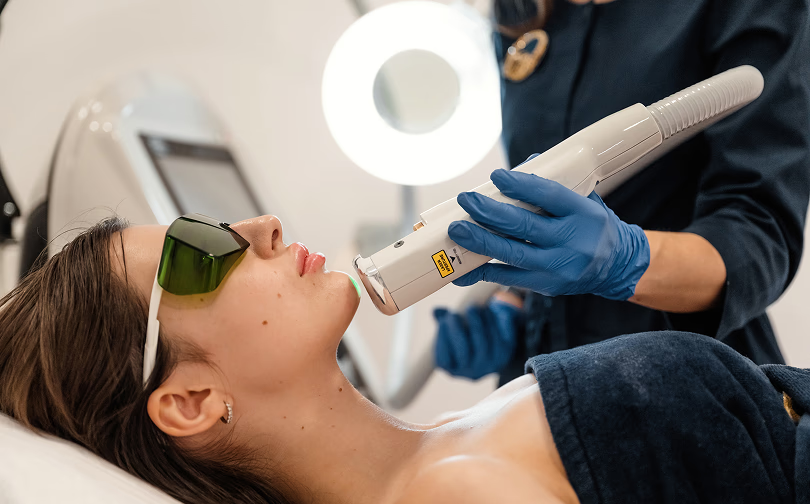
Laser toning
Low-fluence laser toning for stable pigmentation, post-acne marks, and melasma maintenance. Used after topical control, never during a flare.
- Stable pigmentation pattern
- Adjunct to topical care
- Pigment maintenance phase
Tattoo removal
Q-switched laser over 6–12 sessions; pigment-aware for darker skin. Substantial fade realistic; complete erasure uncommon.
- Want tattoo removed
- Multiple ink colours
- Indian skin pigment context
Carbon laser facial
Carbon-mask + low-fluence laser for tone, oil control, and surface refinement on stable skin.
- Oily / dull skin
- Want low-downtime adjunct
- Surface refinement series

Fractional resurfacing
Fractional CO2 or non-ablative fractional laser for boxcar scars and overall texture; conservative parameters on darker skin.
- Acne scars
- Texture refinement
- Stable skin baseline

Pigment-targeted laser
Q-switched and picosecond lasers for selected pigment patterns once topical management is established.
- Stable pigmentation
- After topical control
- Adjunct work

Vascular laser
Pulsed-dye and Nd:YAG lasers for facial redness, telangiectasia, and selected vascular lesions.
- Facial redness
- Visible vessels
- Vascular lesion
Not sure which laser? Pick the closest sentence
If you would describe your concern in one of the phrases below, the chip routes you to the most relevant page. If none quite fit, the unsure chip routes you to the consultation without committing to any treatment.
Featured pages — treatment, pigment and ageing
Treatment-led laser pages, pigment-and-tone pathways, and adjacent anti-ageing pathways combining laser components.
Treatment-led pages
Laser-led skin pathways under Delhi Derma Clinic dermatology care.
Laser Toning
Low-fluence laser for stable pigmentation.
Open pageTattoo Removal
Q-switched laser; pigment-aware.
Open pageCarbon Laser Facial
Tone and oil control protocol.
Open pageAcne Scar Treatment
Fractional resurfacing for scars.
Open pageMicroneedling for Acne Scars
Non-laser scar adjunct often combined with fractional.
Open pagePore Tightening
Surface-refinement protocol; carbon-laser adjunct.
Open pagePigment and tone
Laser adjuncts for pigmentation and brightening pathways.
Pigmentation Treatment
Diagnosis-led pigment care with laser adjuncts.
Open pageMelasma Treatment
Recurrence-aware management with low-fluence laser.
Open pageHyperpigmentation
Targeted brightening for stable hyperpigment patterns.
Open pageSkin Brightening
Tone-correction protocols including carbon laser facial.
Open pageAnti-ageing and tightening
Energy-based pathways including laser components.
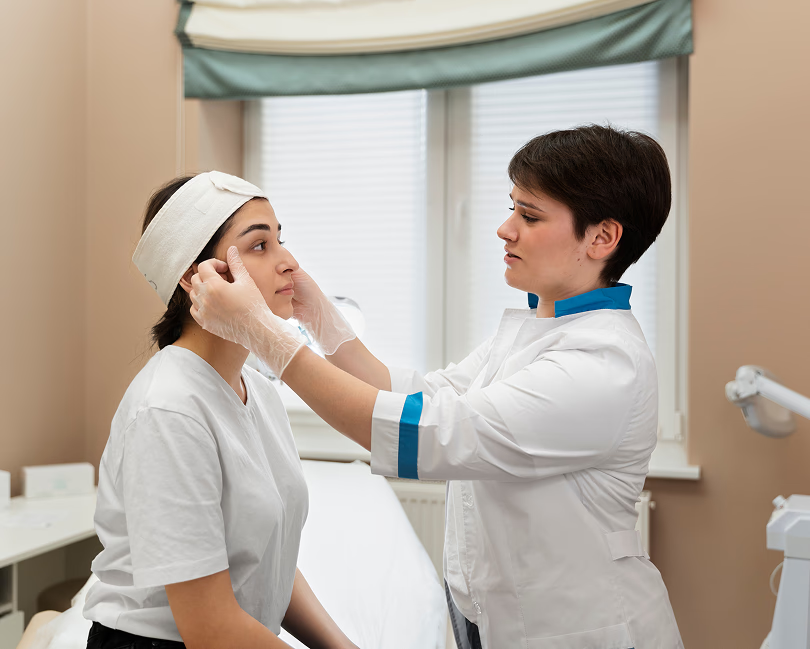
Lasers calibrated for Indian skin
Aggressive imported laser settings cause pigment-rebound that outlasts the original concern. The four operating commitments below set how Delhi Derma Clinic keeps laser care safe for III–V skin.
- Wavelength-by-skin-type matching Laser settings are matched to your specific skin type, not to an imported default. Q-switched parameters for darker skin run conservatively to protect against pigment-rebound on surrounding skin. Operator experience determines outcome more than device brand.
- Conservative pacing on Indian skin Aggressive single-session laser settings produce pigment damage in Fitzpatrick III–V skin that frequently outlasts the original concern. Multi-session courses at conservative parameters produce better and more sustainable result with less complication risk.
- Test-patch protocol For first-time laser exposure on Indian skin, a small test patch in a discreet area lets us calibrate against your specific pigment-rebound profile before treating the visible zone. The protocol is standard at Delhi Derma Clinic for any patient new to laser work.
- Honest realism Lasers are not free of side effects, free of sensation, or absolute in clearance. Lasers carry side effects including pigment change, scar risk, and partial-response patterns. Honest framing at consultation describes ranges and risks rather than promised outcomes.
Decision method and first-visit experience
Laser-pathway decisions begin with confirming the concern is laser-appropriate at all. Many pigmentation patterns respond to topicals first and laser only as a stable-pattern adjunct, not as primary treatment. Multi-session courses across months produce more reliable outcomes than aggressive single-session approaches in Indian skin.
Decision method — six structured steps
- 1
Concern
Pigment, tattoo, scar, surface, vascular — different lasers for each.
- 2
Skin type
Fitzpatrick assessment determines safe parameters.
- 3
Stability
Active disease addressed first; laser on stable skin only.
- 4
Wavelength choice
Q-switched, long-pulse, fractional, or vascular — matched to concern.
- 5
Plan
Written multi-session plan with parameters and intervals.
- 6
Review
Photograph-led review at every visit.
First visit — six things that happen
- 1
Concern review
Discussion of what you want and what laser can deliver.
- 2
Skin assessment
Examination, Fitzpatrick typing, prior pigment-rebound history.
- 3
History
Prior laser treatments, scars, photosensitivity, medications.
- 4
Suitability
Match between concern and laser; honest decline if appropriate.
- 5
Test patch
Small calibration patch in a discreet area for first-time laser.
- 6
Plan
Written sequence with sessions, parameters, expected outcome range.
Indian skin safety — laser calibration
Lasers in Fitzpatrick III–V skin carry meaningful pigment-rebound risk if parameters are not calibrated. Conservative pacing, lower fluence and longer intervals are standard. The test-patch protocol adds an extra calibration step before treating visible zones.
Wavelength selection
Q-switched 1064 nm and 532 nm have different pigment-target profiles; selection depends on lesion type and skin type. Long-pulse Nd:YAG suits darker skin for vascular and hair work because deeper-penetration wavelengths bypass surface melanin.
Fluence and pulse duration
Lower fluence and longer pulse durations reduce pigment-rebound risk in darker skin. The dermatologist sets parameters against your specific skin type rather than against an imported "standard". Calibration evidence is documented at every visit.
Test-patch and pacing
A small test patch in a discreet area lets us calibrate before treating visible zones. Multi-session courses across months produce better outcomes with less complication risk than single aggressive visits.
- Wavelength-matchedSettings chosen against skin type.
- Conservative fluenceLower energy, more sessions.
- Test-patch protocolCalibration before treatment.
- Multi-session coursesSeries outperform single visits.
- Pigment recoveryAftercare for III–V skin.
- Honest declineSome lesions outside laser scope.
What not to do in laser care
The patterns below are the most common reasons laser work goes wrong on Indian skin. Each is preventable with wavelength matching, conservative fluence, test-patch calibration and disciplined post-laser aftercare.
- Do not chase aggressive laser settings.
Higher fluence does not produce better outcomes on darker skin; it raises pigment-rebound risk. Conservative parameters across more sessions are the right pathway in Indian skin.
- Do not have laser during an active flare.
Laser on inflamed melasma, active acne, or barrier-compromised skin produces pigment damage worse than the original concern. Active disease is addressed first; laser follows on stable skin.
- Do not skip the test patch.
For first-time laser exposure on Indian skin, a small test patch lets us calibrate against your specific pigment-rebound profile before treating visible zones.
- Do not skip post-laser sun protection.
Daily SPF on the treated zone for at least 8–12 weeks post-procedure protects against pigment-rebound. Skipping is the leading cause of post-laser dyschromia.
- Do not expect side-effect-free laser.
No laser is absolute in clearance. Recognised side effects include pigment change, mild scar risk, and partial-response patterns. Honest framing at consultation is part of the consent process.
Parent and sibling hubs
The Skin Laser Treatments Hub branches off the Skin Hub. Sibling hubs cover pigmentation, tightening, removals and the laser hair-reduction pathway.
Skin Hub (parent)
Top-level skin gateway.
Open hub Hub · F046Pigmentation Hub
Pigment patterns including laser adjuncts.
Open hub Hub · F050Skin Tightening and Firming Hub
Energy-based tightening pathways.
Open hub Hub · F056Removals Hub
Tattoo and lesion removal pathways.
Open hub Hub · F061Laser Hair Reduction Hub
Hair-reduction laser pathways.
Open hubBeyond the hub — guides and comparisons
Frequently asked questions
Eight questions cover wavelength selection, Indian-skin safety, test-patch protocol, tattoo-removal realism, melasma laser appropriateness, pacing, post-laser care and how cost is structured. The consultation produces the plan that applies to your specific concern after clinical assessment.
-
Are lasers safe for Indian skin?
Yes — when wavelength, fluence, pulse duration, and intervals are calibrated for Fitzpatrick III–V skin. Q-switched 1064 nm and long-pulse Nd:YAG are typically the safest workhorses on darker skin because deeper-penetration wavelengths bypass surface melanin. Aggressive imported settings cause pigment-rebound that outlasts the original concern; calibration is what protects the outcome. The test-patch protocol at Delhi Derma Clinic adds an extra safety step for first-time laser exposure.
-
What is a test patch?
A small calibration patch in a discreet area (often behind the ear or on the inner forearm) treated at the proposed laser parameters before treating the visible zone. The patch lets us observe your specific skin response over 1–2 weeks and adjust parameters before committing to the main treatment. The protocol is standard at Delhi Derma Clinic for first-time laser exposure on Indian skin and reduces the risk of unexpected pigment-rebound on the visible zone.
-
Will laser clear my pigmentation completely?
No — laser does not clear pigmentation completely. For melasma in particular, the realistic objective is sustained reduction with maintenance, not one-time clearance. Low-fluence laser toning has a defined adjunct role for stable patterns once topical management is established; aggressive laser on a melasma flare typically worsens the problem. The pigmentation pathway describes the broader treatment context; laser is one tool, not the whole plan.
-
How many sessions does tattoo removal take?
Typically 6–12 sessions at 6–8 week intervals depending on tattoo size, age, ink colour mix, and skin type. Black ink responds best; greens, yellows, whites, and complex multi-colour tattoos less reliably. Substantial fade is realistic; complete erasure is uncommon. Patient-selection conversation at consultation honestly identifies pigments that may not respond at all and sets the realistic outcome range before treatment begins.
-
Is laser hair reduction the same as laser hair removal?
No — and the distinction matters. "Laser hair reduction" is the accurate clinical framing: substantial reduction in hair density and thickness, sustained on maintenance, but rarely complete elimination of all hair growth. "Total hair removal" promises that some clinics make are not supported by clinical evidence. The Laser Hair Reduction Hub covers this in detail with honest reduction-not-removal language.
-
Are lasers painful?
Lasers produce sensation that varies by patient, device, and treated zone. Most patients describe it as mild to moderate stinging or rubber-band snap; topical numbing cream, cold air, and contact cooling reduce sensation meaningfully. "free of sensation laser" is a marketing claim, not an evidence-based description. The honest framing at consultation describes what to expect.
-
What does post-laser aftercare look like?
Daily broad-spectrum SPF 30+ on the treated zone for at least 8–12 weeks post-procedure is the most important step. Gentle barrier-supportive routine, avoiding active actives (retinoid, vitamin C) for the first 7–10 days, and avoiding hot showers / heavy sweating for 24–48 hours are standard. Skipping post-laser sun protection is the leading cause of post-laser dyschromia.
-
How much does laser treatment cost at Delhi Derma Clinic?
Consultation starts from ₹1,999*. Beyond consultation, cost depends on the laser pathway (toning, tattoo, carbon facial, fractional resurfacing, vascular), the session count, and the body area treated. Indicative ranges are provided in writing at the consultation. Tattoo removal is priced per session over a typical 6–12 session course; toning and resurfacing as multi-session protocols.

Get the right laser pathway calibrated for your skin
The next step is identifying which laser fits your concern, your skin type and your timeline — with parameters set against your specific Fitzpatrick assessment. That happens at the consultation.
Starting from ₹1,999*. Final cost is explained in writing at the consultation.
Last reviewed April 2026 by Dr Chetna Ghura, MBBS MD Dermatology, DMC 2851. Next review due April 2027. Medical education only — not a diagnosis or prescription.